Smart Contract Audit
Prevent costly exploits, protect user funds, and launch with confidence. Hacken’s smart contract audit combines senior-led code review, structured testing, and real-world exploit analysis – trusted by 1,500+ projects securing over $180B+ in digital assets.

Security partner for Web3 builders, enterprises, and governments since 2017




















- 16,659
- vulnerabilities identified
- 60+
- certified security engineers
- ISO 27001
- certified
- SOC 2
- Type II compliant
What is a smart contract audit?
A smart contract audit is a structured security review of a smart contract's source code. Auditors examine logic, dependencies, permissions, and state transitions to find vulnerabilities and high-impact edge cases before they reach production.
Professional audits combine three layers:
Automated scanning:
detect known vulnerability patterns across the full codebase.
Manual code review:
senior engineers analyze logic flaws, access controls, and economic exploits that tools miss.
Dynamic testing:
fuzzing, invariant checks, and integration tests to stress-test behavior.
Why audits are critical in 2026
In practice: the biggest damage comes from broken authorization and control paths. That's why we focus on who can do what, under which constraints, and how funds move – not just pattern matching.
Regulatory and listing requirements are rising. EU regulatory frameworks (including MiCA) raise expectations around security and risk controls, and major exchanges and partners commonly require third-party audits for listings and integrations.
Why choose Hacken

9 years
1,500+ clients
2,161 assessments
Double coverage audits
Two senior auditors review in parallel to reduce blind spots and increase accuracy.
Dedicated delivery manager
A single point of ownership to keep scope, timeline, and communication tight.
Direct access to auditors
Ongoing guidance throughout the engagement – fast answers, actionable fixes.
Real-time audit portal
Live progress tracking, findings management, and role-based collaboration in Hacken Portal.
Fuzz & invariant testing
Deeper detection for edge cases and unexpected states – delivered post-audit when in scope.
Verified remediation
Submit unlimited in-scope fixes within two weeks and confirm everything is resolved pre-deployment.
Post-audit reassurance
Traditional audit with crowdsourced security testing to increase coverage beyond a single review cycle.

Hear from our clients

Isha Tyagi
Technical Program Manager, Near

Ilya Naryzhnyy
CIO, 1inch

Jason, Seong Ho Lee
DeFi Product Owner, Wemade

Sunny Lu
CEO, Vechain

Tony Wei
CTO, Gate.io

Qevan Guo
Co-founder, IoTeX
Ruben Guevara
DevOps Engineer Security Oriented, PAID NetworkWhat you get from a Hacken smart contract audit
Prioritized findings your engineers can ship against
Clear severity, impact, and fix guidance – structured for fast triage and remediation.
Verifiable PoCs for High/Critical issues
For severe findings, we include exploit descriptions as verifiable scenarios so your team (and stakeholders) can understand real-world risk.
A report you can share with partners and exchanges
A clean audit narrative: scope, system overview, risks, findings, definitions, fuzz/invariant results if applied.
Remediation verification
You can submit in-scope remediations within two weeks; we re-check fixes, confirm they don't introduce new risks, and update statuses for the final report.
Real-time visibility in Hacken Portal
Track progress, collaborate with the team, and manage findings in one place with role-based involvement and live tracking.

Our smart contract audit process
A repeatable methodology built for speed and depth: double manual coverage, structured testing, and real-time reporting.
Explore our full audit methodology
We align on scope, threat model, timelines, and expected behavior for critical flows before the review begins.
- Manual review with double coverage: auditors perform a simultaneous line-by-line review independently.
- Automated scanning: static/dynamic tools complement the manual review and catch common patterns early.
- Fuzz and invariant: to uncover unexpected states and broken rules.
Findings are recorded in a secure reporting portal and shared during the engagement so your team can prioritize fixes early. High/Critical issues include verifiable exploit scenarios.
After the initial report, we verify that fixes resolve the issues and don’t introduce new risks, then publish a final comprehensive report. A dedicated QA step validates severity accuracy, reproducibility, consistency, and completeness.
- Extended security validation: crowdsourced testing to increase coverage beyond a single review cycle.
- Real-world attack simulation: independent attack-path exploration to surface edge cases.
- Post-audit assurance: useful after fixes, upgrades, or before launch, listings, and external due diligence.
Most common smart contract vulnerabilities
Based on insights from 2,161 smart contract audits, the following vulnerability classes appear most frequently – and account for the majority of high-impact security incidents when left unaddressed.
Reentrancy & read-only reentrancy
Attackers call a function before the previous execution completes, draining funds in a loop. Read-only reentrancy exploits view functions to manipulate pricing data in external protocols.
Access control & authorization failures
Unprotected admin functions, missing role checks, or flawed ownership transfer logic. Accounted for 53% of total Web3 losses in 2025.
Oracle manipulation
Exploiting price feed dependencies to create artificial arbitrage, drain lending pools, or manipulate liquidations.
Mathematical discrepancies
Rounding errors and precision loss allow extraction across many transactions.
Cross-chain deposit discrepancies
Inconsistent state handling between chains that lets attackers credit deposits that never finalized or double-spend bridged assets.
Front-running & MEV
Exploiting mempool visibility to sandwich transactions or extract MEV from predictable on-chain actions.
Insufficient input validation
Missing boundary checks, unchecked return values, or accepting malformed data that puts the contract in an unintended state.
Faulty time-based logic
Relying on block timestamps for critical logic (lock periods, vesting schedules, auction deadlines) without accounting for miner manipulation.
Incorrect external integration
Misusing external contract interfaces, failing to handle deprecated functions, or making unsafe assumptions about third-party protocol behavior.
Improper state variable management
State variables that aren't reset after use, storage collisions in upgradeable contracts, or uninitialized variables carrying default values that bypass intended logic.
How to prepare for a smart contract audit
Good preparation cuts audit time and cost. Five things that make the biggest difference:
- Builds/tests run smoothly
- Codebase is stable (no major refactors mid-audit)
- Architecture and permissions are documented
- Core fund flows are covered by tests
- Scope is clearly defined
If you’re mid-build, we can start with a readiness review to lock scope and reduce rework.
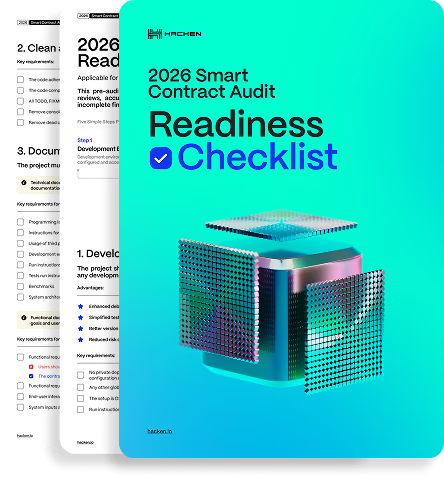
Audit Readiness Checklist
Prepare your repo, docs, and team before the audit starts.
Explore our audit reports
See how Hacken's audit reports look in practice. Browse completed assessments
across DeFi, infrastructure, and enterprise blockchain.






Platforms and languages we support
Whether it's Solidity on Ethereum, Rust on Solana, Move on Sui, or any other combination – we've got you covered.


Industry leaders rely on Hacken for their Web3 security




Active memberships










Driving excellence in blockchain security since 2017