Tokenized stocks put exposure to traditional equities on a blockchain. Depending on the product, a token may represent a claim on a share held by a custodian or a debt security that tracks the share's price.
The appeal is straightforward: blockchain tokens can trade outside traditional market hours, move between wallets and potentially be used in DeFi applications such as lending and collateral.
The market has now passed $3 billion in on-chain value, while the number of holders more than doubled in a single month to 1.31 million by mid-August.
The regulatory picture also changed in September, when the US Securities and Exchange Commission (SEC) opened a conditional route for on-chain trading of tokenized US-listed stocks. We explain what that exemption allows in a separate guide to the SEC Innovation Exemption.
This guide explains how tokenized stocks work, what holders own, how Coinbase and Robinhood structure their products, and where tokenized stocks have already created security risks in DeFi.
How does a stock become a token?
The basic structure is easier to understand by following one share through the system.
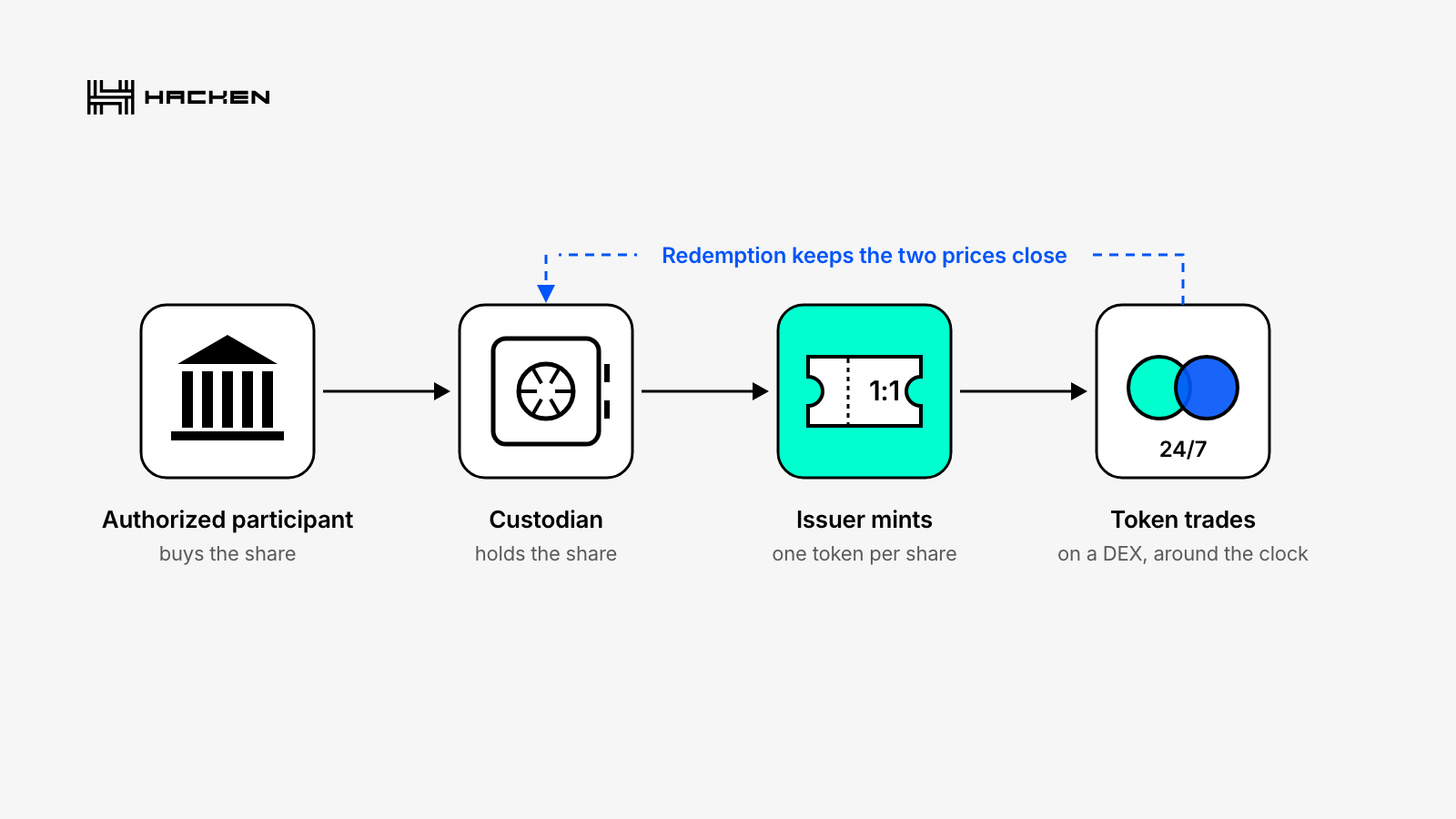
Suppose an institution wants to issue a token representing one Alphabet share.
- Purchase. An authorised participant or other institution acquires the underlying share through the traditional market.
- Custody. A custodian holds the share. The token exists on-chain while the underlying security remains in custody.
- Minting. The issuer creates the corresponding token according to the product's legal and technical structure. Depending on the issuer, KYC may be required at issuance and redemption.
- Trading. The token can then move between wallets and trade on supported venues. For current offshore products, secondary trading on-chain is generally permissionless.
- Redemption. Where the product permits redemption for the underlying share or its cash value, authorised participants can arbitrage differences between the token and the underlying asset.
That last mechanism helps keep the token's market price close to the underlying share.
The important distinction is that the share and the token are not the same thing. The share remains in the traditional financial system. The token is the blockchain representation or legal claim defined by the issuer.
Once issued, the token can also be integrated into other blockchain applications. For example, Base has documented tokenized stocks being used as collateral in Aave's Equities Hub.
This is where tokenized stocks become more than a way of moving traditional securities onto a blockchain. They can become building blocks for on-chain financial applications.
What do you actually own when you hold a tokenized stock?
The answer depends on the product's legal structure.
A token can provide exposure to the price of a share without giving the holder all of the rights attached to direct ownership of that share. Some products represent an interest backed by custodied securities. Others are structured as debt securities whose value tracks the underlying stock.
That distinction affects several things.
Voting rights. A tokenized stock does not automatically give its holder the same shareholder rights as the underlying share. The rights depend on the issuer's legal structure and terms.
Dividends. The way dividends are passed through to token holders depends on the product. Tokenized-stock systems may use contract accounting mechanisms rather than issuing additional tokens.
Stock splits and other corporate actions. Some token standards use a multiplier to represent the relationship between the token balance and the underlying asset. That multiplier can change after a split or other corporate action.
Base's documentation, for example, uses uiMultiplier() to account for changes in the number of underlying shares represented by a token. This means an integration cannot safely assume that one token will permanently represent exactly one share.
Redemption. Not every holder necessarily has the same redemption rights. Some products restrict redemption to authorised participants, while others allow qualifying holders to redeem.
For anyone integrating a tokenized stock into DeFi, these details matter more than the ticker symbol.
Tokenized stocks also have an oracle problem
Traditional stock markets close. Blockchains do not.
A tokenized stock can continue trading on a DEX while the underlying stock exchange is closed. The price feed may therefore remain unchanged while the token's on-chain market continues moving.
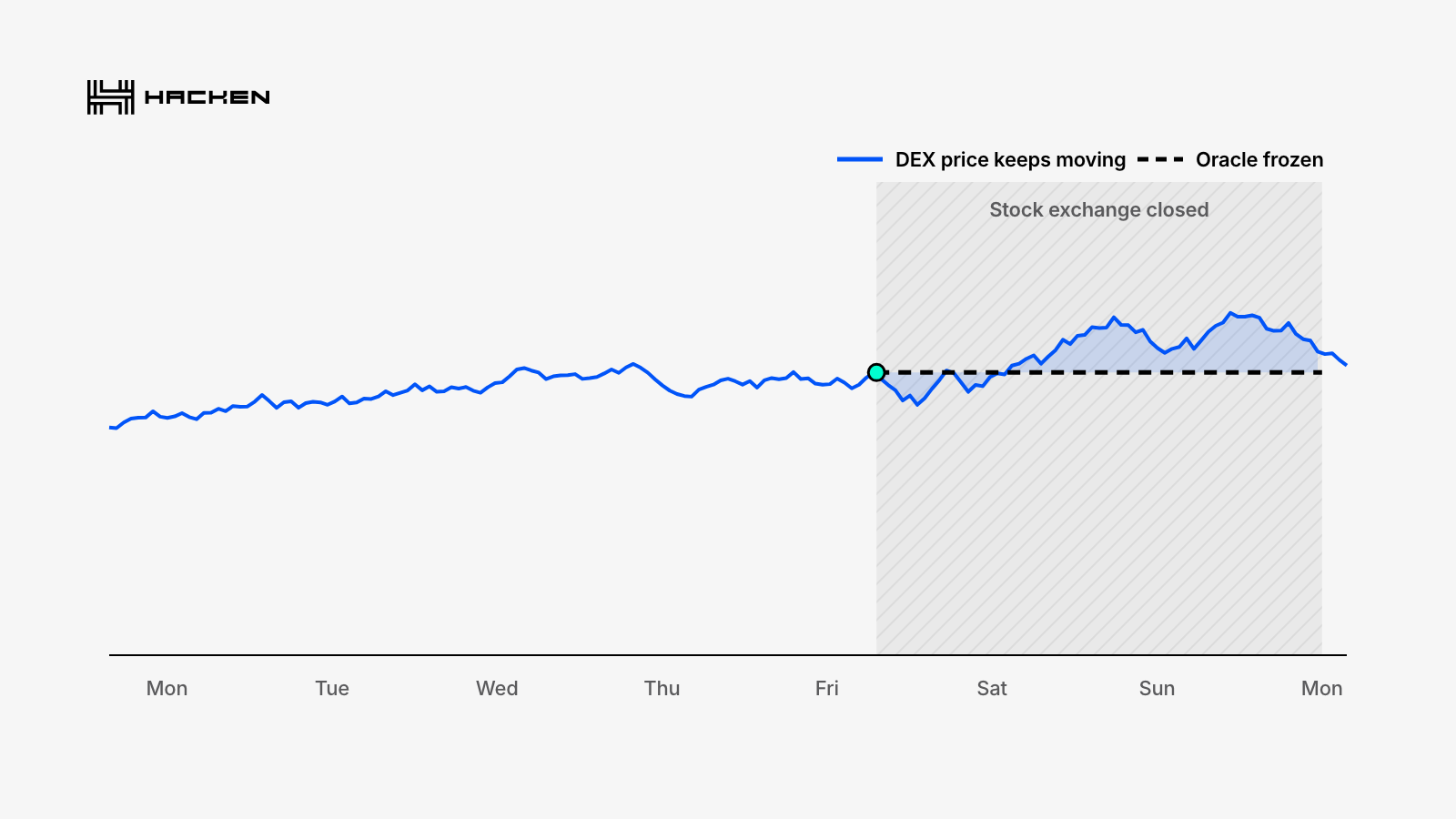
That creates a familiar DeFi problem in a new context.
A lending protocol may have to decide what a tokenized stock is worth on Saturday when the underlying market has been closed since Friday. It also has to account for stale prices, corporate actions, issuer controls and differences between the underlying asset and any wrapped version used by the protocol.
An oracle therefore does not solve the entire pricing problem. It only provides one input into it.
Coinbase vs Robinhood tokenized stocks
Coinbase and Robinhood illustrate two different approaches to tokenized equities.
Coinbase launched tokenized stocks on Base using its B20 token standard. Base describes B20 tokens as native precompiles rather than separately deployed contracts, with issuer controls built into the standard. These controls include functions such as address blocklisting, pausing and changing the multiplier.
Robinhood takes a different legal approach. Its tokenized stocks are described as tokenized debt securities that provide economic exposure to the underlying shares without granting legal or beneficial ownership of those shares.
The technical difference matters to anyone building on top of these assets.
If a token issuer can freeze addresses, your protocol has to account for what happens when a borrower holding the token as collateral becomes blocked.
If the token represents a debt claim rather than direct ownership of the underlying share, your protocol also needs to understand what exactly it is accepting as collateral.
Tokenized-stock integrations should therefore be evaluated at the contract, issuer and legal-claim levels rather than treating every product with the same ticker as equivalent.
The key takeaway
Tokenized stocks combine two systems with very different assumptions.
The underlying share belongs to the regulated securities market, with custodians, exchanges, corporate actions and market hours. The token belongs to a blockchain environment where assets can move continuously, contracts can compose with one another and market participants can build new financial logic around them.
If your protocol is integrating tokenized stocks as trading pairs, vault assets or collateral, Hacken's RWA smart contract security audit tests the parts that break: multiplier handling, oracle behaviour when markets close, issuer controls and wrapper exchange rates.
Frequently asked questions about tokenized stocks
FAQ
Frequently asked questions about tokenized stocks.
Is a tokenized stock the same as owning the share?
Not necessarily.
A token may provide economic exposure to a share without giving the holder the same legal rights as a direct shareholder. The answer depends on the product's legal structure.
The SEC's TSV framework takes a different approach: tokenized NMS stock traded under the exemption must provide the same rights and privileges as the traditional security, including voting and dividend rights.
Can US residents buy Coinbase or Robinhood tokenized stocks?
The existing products described above are offered outside the US. The SEC's September 2026 exemption creates a new route for qualifying US venues to facilitate on-chain trading of certain tokenized NMS stocks, but it does not automatically make every existing tokenized-stock product available to US residents.
A venue operating under the exemption must meet the conditions of the SEC order.
How do tokenized stocks handle dividends and stock splits?
There is no single mechanism.
Some tokenized-stock systems use a multiplier that changes the relationship between the token and the underlying asset after a corporate action. An integration should therefore not assume that one token permanently represents one share.
The exact treatment depends on the issuer and token standard.
What is the difference between Coinbase and Robinhood tokenized stocks?
Coinbase's tokens on Base are backed by custodied shares and use the B20 standard, which gives the issuer blocklisting, pause, rename and multiplier controls. Robinhood's tokens are debt securities that track the share price without granting legal or beneficial ownership of the shares. Neither currently gives holders voting rights.
Why can tokenized stock prices move when the stock market is closed?
The underlying exchange closes, but the token keeps trading on-chain. Price feeds stop updating when the market closes, so a lending protocol can still be valuing a token at Friday's closing price while its DEX price moves over the weekend.
Can tokenized stocks be used as DeFi collateral?
Yes, some already are.
But the collateral risk is broader than the price of the underlying stock. A lending protocol also has to account for the token's contract logic, issuer controls, oracle behaviour, wrappers and exchange-rate mechanisms.
The July 2026 Edel Finance exploit demonstrates why. The underlying stock price feed remained correct while a wrapped representation of the tokenized stock was manipulated and accepted at an inflated collateral value.