Choosing a smart contract auditor is less about finding one universally "best" firm and more about finding a reviewer suited to the code and the evidence the project needs. An EVM protocol, a Daml contract on Canton, a Solana application and a zero-knowledge system can require very different expertise. The same applies when the audit report will be reviewed by an exchange, a bank, an institutional investor or a regulator.
For this comparison, we shortlisted firms using three criteria: their presence across independent 2026 comparisons of smart contract audit companies; a distinct technical specialisation or delivery model; and publicly documented work for exchanges, custodians, financial institutions or regulated crypto businesses.
The firms are listed alphabetically and are not ranked.
Smart contract audit companies compared
"Quote" means the firm does not publish a standard audit price. Published contest prize pools are shown separately from private audit pricing.
What makes one smart contract auditor a better fit than another?
For a standard Solidity project on an EVM chain, there are many established providers. For code written in Rust, Move or Daml, the experience of the assigned researchers becomes more important. Cryptographic implementations and zero-knowledge systems can require expertise beyond conventional Solidity auditing.
The delivery model is also important. A conventional audit assigns a team to a defined scope and produces a report of vulnerabilities, severity and recommendations. An audit contest opens the same code to many researchers for a defined period. A formal verification engagement proves specified properties of the system against a formal model.
When choosing, consider the number of chains supported by auditor, the time of delivery, whether auditor just flags findings or supports your team through remediation and re-audit free of charge, which Hacken does.
Which smart contract audit firms fit which projects?
EVM and general smart contract audits
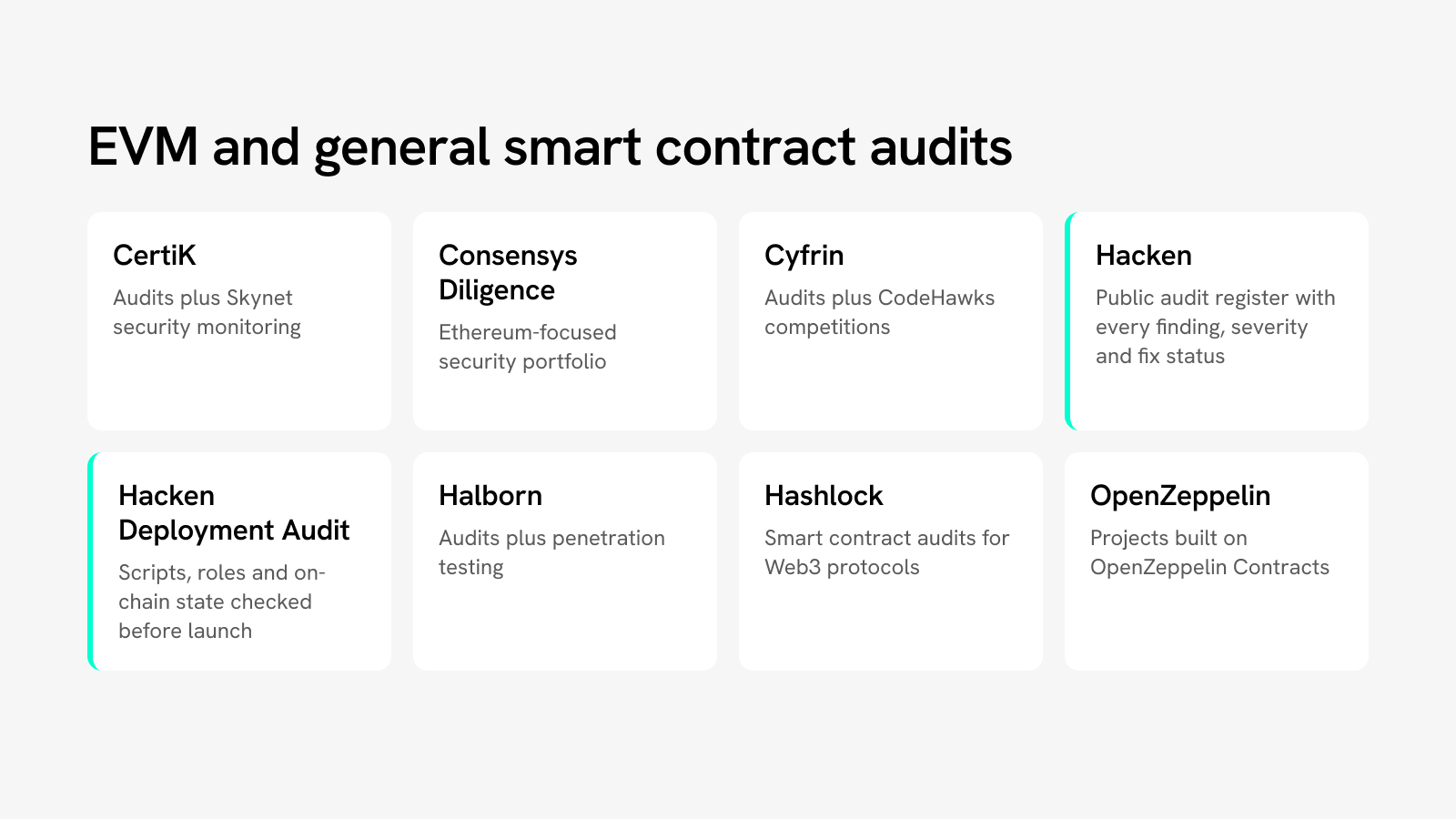
CertiK, Consensys Diligence, Cyfrin, Hacken, Halborn, Hashlock and OpenZeppelin all publish conventional smart contract audit work.
This is the broadest part of the market. When choosing between these firms, look beyond the number of audits claimed and check whether the published work resembles the project under review: similar architecture, language, dependencies, chain and business logic.
OpenZeppelin is particularly relevant for projects built on OpenZeppelin Contracts. Consensys Diligence has an Ethereum-focused security portfolio. Cyfrin combines audits with its CodeHawks competition platform, while CertiK combines audits with its Skynet monitoring product.
Hacken's public audit register is another way to examine completed assessments and their findings.
Formal verification
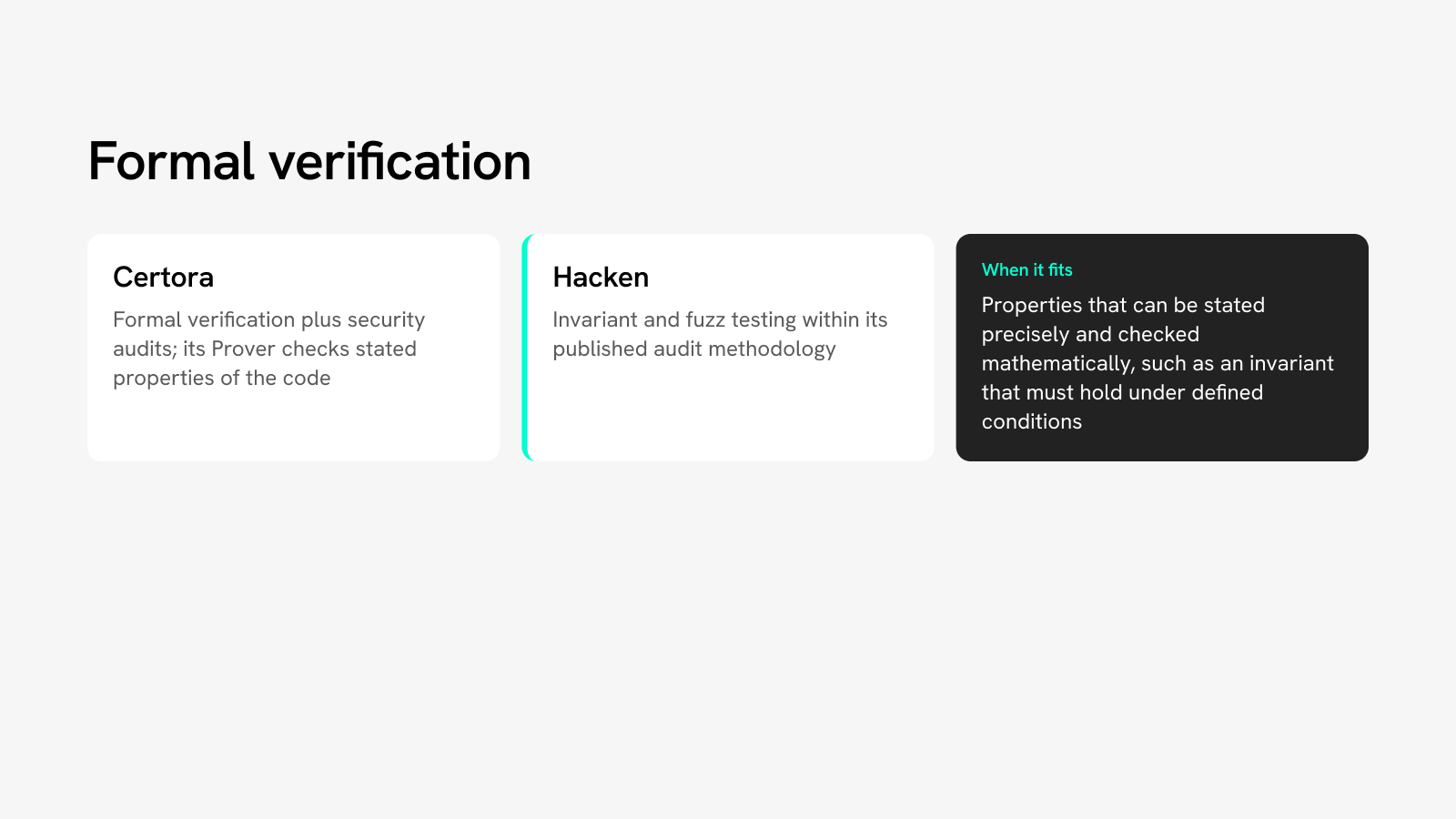
Certora focuses on formal verification as well as security audits.
Formal verification is useful when a project has properties that can be stated precisely and checked mathematically. For example, a protocol may need to establish that a particular invariant holds under defined conditions.
This is different from running more automated tests. The quality of the result depends on the properties being specified correctly and on the assumptions made by the formal model.
Hacken's published audit methodology includes invariant and fuzz testing, which exercise stated properties under many inputs; that is testing rather than a formal proof.
Audit contests
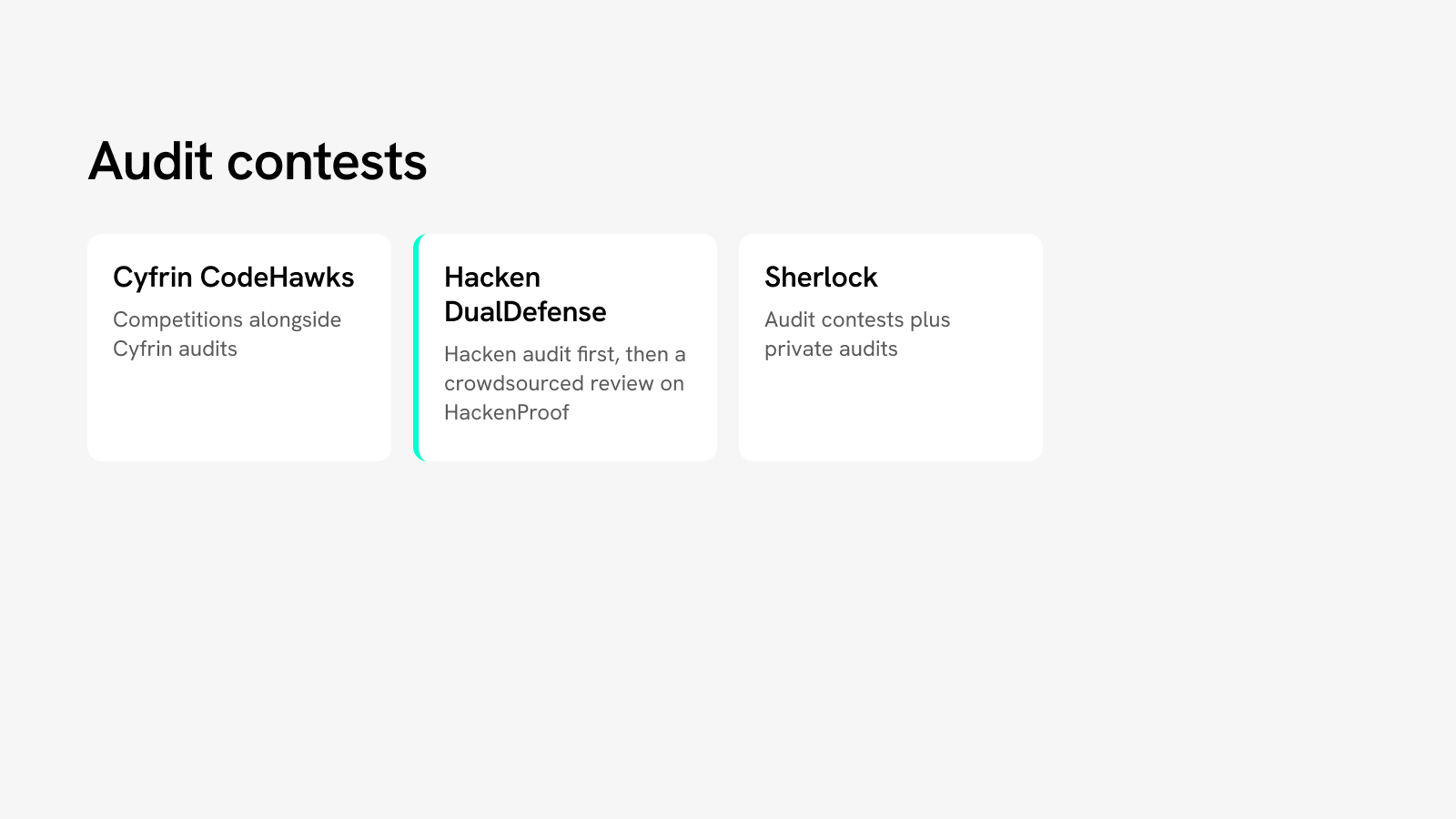
Sherlock, Cyfrin's CodeHawks and Hacken's DualDefense use competitive researcher models alongside other audit services.
A contest brings many independent researchers into the same codebase for a defined review period. This increases the number of independent approaches to the code, but it is still a different product from a conventional audit engagement.
Hacken's DualDefense runs both models in one engagement: after the Hacken audit, the code goes to a crowdsourced review on HackenProof, a separate Hacken-family bug bounty platform.
Sherlock's published $20,000 to $200,000+ figures describe contest prize pools. They should not be treated as standard private audit prices.
Specialist languages and systems
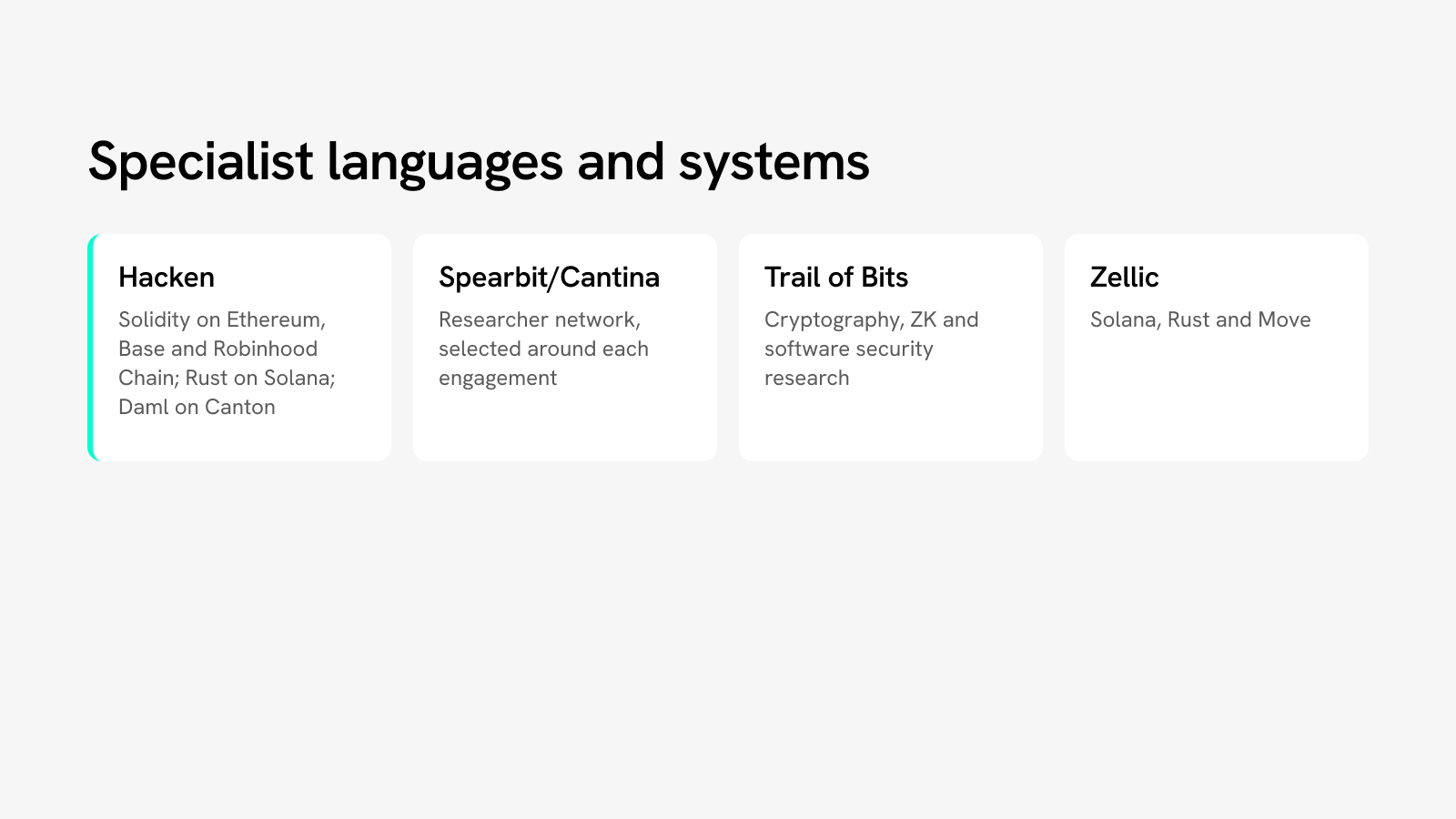
Zellic publishes security work involving Solana, Rust and Move.
Trail of Bits publishes research covering cryptography, zero-knowledge systems and broader software security, alongside its auditing work.
Hacken audits Solidity on EVM chains such as Ethereum, Base and Robinhood Chain, Rust on Solana, and Daml on Canton.
Spearbit/Cantina uses a network of security researchers and is relevant when a project wants specialists selected around the technical characteristics of an engagement.
These firms become particularly relevant when the project's main security assumptions fall outside a conventional Solidity-only review.
Which firm fits a financial institution or regulated crypto company?
For exchanges, custodians, stablecoin issuers and banks, the audit is often one part of a larger security evidence package. In the US, the GENIUS Act, the federal framework for payment stablecoins, raises the bar for that evidence; in the EU, MiCA and DORA do the same.
Several firms publicly market services to exchanges, custodians or regulated financial businesses, including CertiK, Cyfrin, Hacken, Halborn, Hashlock, OpenZeppelin and SlowMist.
Hacken audits and penetration-tests exchanges and regulated crypto firms. It performed the CCSS audits behind WhiteBIT's CCSS Level 3 and Bitso's CCSS certification, and, according to its published case study, a penetration test mapped to MiCA and DORA controls that Bybit used for its MiCA licence in Austria.
Those engagements are not the same type of assessment. WhiteBIT and Bitso involved CCSS audits; the Bybit engagement was a penetration test, not a smart contract audit. That distinction is important when comparing evidence.
What does a smart contract audit cost?
Most smart contract audit firms publish no standard price and quote after reading the code. The main cost drivers are the amount and complexity of code, the number of contracts and dependencies, the architecture, the number of researchers, and whether the review of fixes is included.
Market references from Sherlock, Procur3 and TokenMinds put private audits at about $5,000 for a simple token and $80,000 to $150,000+ for complex or ZK systems. Contest prize pools are a separate figure.
Hacken quotes after reviewing the code rather than publishing a fixed rate; its smart contract audit page takes requests.
What should a smart contract audit cover?
The scope should be agreed before the review begins.
At minimum, the audit should identify the exact contracts and commit under review. It should also make clear whether dependencies, upgrade mechanisms, privileged roles, oracles and cross-chain components are included.
The review itself normally combines automated analysis with manual security research. Automated tooling can identify classes of known issues, while manual review is needed to reason about protocol-specific business logic and interactions between contracts.
A useful report makes findings actionable. For each material issue, a buyer should be able to understand the affected component, the security impact, the conditions required for exploitation and the recommended remediation.
The remediation process counts too. A report issued before fixes are reviewed is different evidence from a report accompanied by a documented re-review.
What an audit does not cover
An audit does not mean a protocol cannot be exploited.
It reviews the defined scope at the time of the engagement. Risk can remain in code that was not included, changes deployed after the audit, privileged accounts, external dependencies, bridges, or infrastructure surrounding the contracts.
This is why the audit scope should be read together with the final deployment. A project that changes its contracts after an audit should not present the original report as an assessment of the new deployment unless the changes were reviewed.
A deployment audit covers the step between the audited code and production. Hacken's checks deployment scripts, initialisation, proxy and upgrade rights, roles and the final on-chain state against the approved release plan, on EVM and Solana.
Hacken vs CertiK
Hacken and CertiK both sell security services to exchanges.
CertiK's public offering combines smart contract audits with Skynet monitoring and publishes work involving exchanges and custodians.
Hacken's offers smart contract audits across 100+ EVM chains, AI Audits, CCSS audits and a penetration test, a threat-led penetration test (TLPT) mapped to MiCA and DORA controls. Its public audit register also gives access to security assessments and findings.
The biggest difference is that CertiK focuses primarily on smart contract auditing, blockchain protocols, and real-time security intelligence across major ecosystems, while Hacken provides smart contracts audits across 100+ EVM chains/Solana and focuses on broader cybersecurity and compliance offerings like MiCA/DORA, VARA, GENIUS Act, NIS2, SOC 2, ISO 27001/42001, MAS, etc.
FAQ
What is the best smart contract audit company?
There is no single auditor that fits every smart contract project. For conventional EVM contracts, the shortlist is broad. For formal verification, audit contests, cryptography, ZK, Solana, Rust or Move, specialist firms may be more relevant. For financial institutions and regulated crypto firms (GENIUS, MiCA, DORA), firms with documented work in that environment include CertiK, Cyfrin, Hacken, Halborn, Hashlock, OpenZeppelin and SlowMist.
How much does a smart contract audit cost?
Most smart contract audit firms publish no price and quote after reviewing the code. Sherlock's widely cited $20,000 to $200,000+ figure refers to contest prize pools, not private audit fees.
Which firm should a crypto exchange or regulated company hire?
Start with firms that have published comparable work for exchanges, custodians or regulated crypto companies. Check whether the proposed engagement is an audit, a penetration test or another assessment, and whether its scope produces the evidence the organisation needs. Hacken's published exchange work includes CCSS audits for WhiteBIT and Bitso and a penetration test for Bybit mapped to MiCA and DORA controls.
Which firms work with regulated crypto companies under GENIUS, MiCA or DORA?
CertiK, Cyfrin, Hacken, Halborn, Hashlock, OpenZeppelin and SlowMist publicly market services to exchanges, regulated crypto businesses or regulatory frameworks such as MiCA and DORA. Their services are not identical, so buyers should check the documented engagement and the proposed scope.
How does Hacken compare with CertiK?
Hacken and CertiK both sell to exchanges. CertiK combines audits with Skynet monitoring, while Hacken's published exchange work includes CCSS audits and a MiCA- and DORA-mapped penetration test.
Does a smart contract audit guarantee that a contract is secure?
No. An audit assesses the defined scope at a particular point in time. It does not automatically cover later code changes, out-of-scope contracts, privileged infrastructure or external dependencies.