Overview
Hacken is a member of the ERC-3643 Association and the security auditor behind the standard’s reference smart contract implementations. Between December 2022 and February 2025, Hacken completed security reviews across three core contract suites for Tokeny and BlockRidge: the T-REX token suite, the ONCHAINID identity framework, and BlockRidge's implementation of the standard on Base.
About ERC-3643, Tokeny and BlockRidge
ERC-3643 is an open standard for tokenized securities: fund units, bonds, shares, and other assets where the law decides who may hold them. Every transfer runs two checks before anything moves. isVerified() confirms the receiver's wallet is linked to an ONCHAINID carrying the claims the token requires, such as KYC or accredited-investor status, signed by a verifier the issuer trusts. canTransfer() checks the offering's own rules: permitted countries, holder caps, lock-up periods, investment limits. If either fails, the transfer reverts.
The ERC-3643 Association is a Luxembourg non-profit founded in July 2023 to educate markets on the standard, support the people building with it through working groups, and represent it to lawmakers, regulators, and standards bodies. It now has 151 members, including Invesco, Apex, ABN AMRO, Ledger, Fireblocks, Chainlink Labs, Hacken, Polygon, DTCC Digital Assets, Fujitsu, DLA Piper, and Mayer Brown.
Tokeny built and maintains the reference implementations of both halves — the T-REX token suite and the ONCHAINID identity framework — which other issuers and platforms build against. BlockRidge implemented the standard on Base, adding escrow settlement, fund configuration and dividend distribution on top of the inherited compliance framework.
Hacken's Role in the Standard
Hacken contributes directly to the Technology & Security Working Group, reinforcing the safety and resilience of the standard, and co-authored the association's 2024 research report, Demystifying ERC-3643.
Why Regulators Are Naming the Standard
Tokenized securities need more than an ERC-20 interface. They need a way to enforce investor eligibility, restrict transfers according to offering rules, and retain issuer controls over assets after issuance. ERC-3643 builds these functions into the token's architecture.
That design is increasingly reflected in regulatory discussions. The ERC-3643 Association describes the standard as "referenced by regulators and standards bodies" and identifies ESMA, the US SEC and German authorities among them. Its stated ambition goes further: to establish one open standard that allows tokenised securities from different issuers and platforms to operate under shared rules. This is the interoperability problem that standardisation is meant to solve.
The regulatory recognition has developed over several years. In October 2023, ESMA cited ERC-3643 in its study of the DLT Pilot Regime. That December, Ethereum granted the proposal Final status, establishing it as an official Ethereum standard.
In July 2025, SEC Chairman Paul Atkins brought ERC-3643 into a more direct regulatory context. Outlining conditions for a proposed innovation exemption, he said issuers might be required to restrict tokenised securities that do not follow a compliance-enabled token standard, naming ERC-3643 as an example. Two months later, the German industry association BfeW declared ERC-3643 conformant with its framework standard for eWpG-aligned electronic securities.
The clearest institutional application followed in December 2025. In its request for no-action relief for a three-year tokenisation pilot, The Depository Trust Company (DTC) committed to restricting tokenisation protocols to compliance-aware standards such as ERC-3643. It identified two required capabilities: distribution control, ensuring tokens can only move to registered wallets, and transaction reversibility, allowing DTC to force transfers when necessary. Both map directly to ERC-3643's identity registry and agent controls. SEC staff granted the requested relief on 11 December 2025.
Audit Approach
Hacken reviewed each system across multiple rounds, with remediation verified in a re-review before each final report. The ONCHAINID review followed NIST SP 800-115; the T-REX and BlockRidge reviews followed Hacken's own smart contract audit methodology.
- Token logic, minting, burning, freezing, and forced transfers
- Modular compliance and individual compliance modules
- Identity registries, trusted issuer management, keys and claims
- Proxy upgradeability and factory deployment
- Escrow settlement, fund configuration and dividend distribution
- ERC-3643 to ERC-20 wrapping
Key Findings
Access control on compliance binding. Both critical findings in the T-REX review concerned access control. Module binding could be invoked by any address, allowing an unauthorized caller to detach a compliance contract from its module and halt token issuance. Identity registry binding functions had no access restriction despite the specification limiting them to the owner. Both findings were fixed.
Value handling and interface gaps. ONCHAINID's critical finding concerned its execute() function, which accepted a value parameter without checking it against the value actually sent with the call. Other findings covered interface behaviours the implementation did not provide, including multi-key approval thresholds and claim-request handling. For a framework third parties integrate against, a gap between the documented interface and the deployed behaviour is a security property rather than a documentation defect.
Upgradeability and storage layout. Contracts reached through proxies lacked recommended storage gaps for future upgrades. The BlockRidge audit identified related issues in gap placement and a proxy slot conflict.
Risks in the layers built on top. BlockRidge's findings sat mostly in its own extensions rather than in the standard it inherited: insufficient deposit validation in the escrow controller, and fee calculations in the ERC-20 wrapper drawing on stale supply data. Two sat in the compliance layer — check ordering that allowed a hold-period restriction to be bypassed, and a maximum-balance rule that interfered with wrapping.
Audit Results
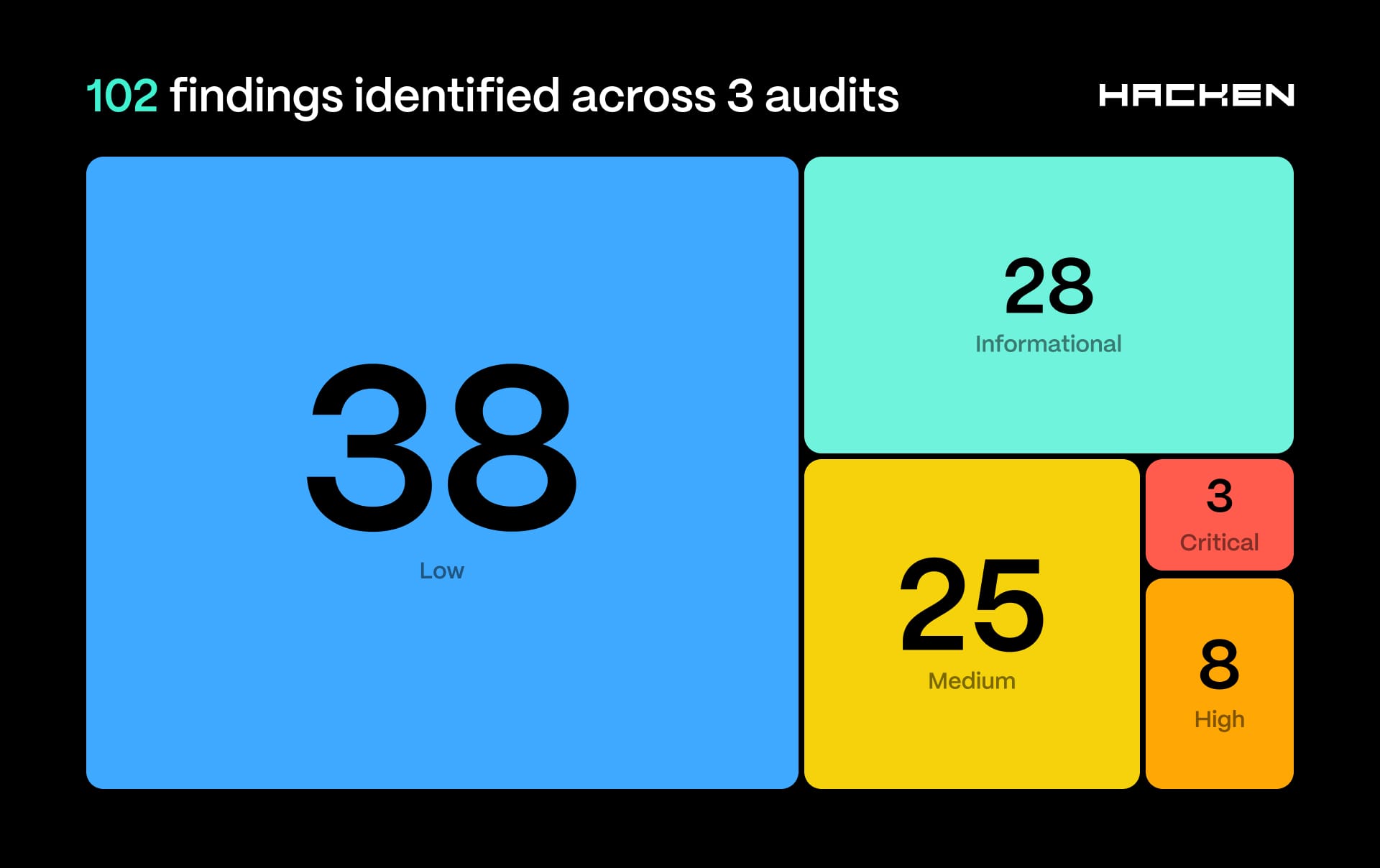
The three reports record 102 findings, 22 in T-REX, 35 in ONCHAINID and 45 in BlockRidge:
Across the three engagements, 94 findings were resolved and 8 were mitigated in the final reports.
The mitigated findings include ONCHAINID's single Critical finding, which Tokeny documented as intended protocol design with an architectural rationale accepted at the time of the review.
Key changes delivered:
- Access control was added to compliance-binding and registry-binding functions
- Burn was brought back into line with its documented behaviour, and missing deposit validation was added
- The ONCHAINID approval and execution flow was reworked to remove the replay and denial-of-service conditions
- Storage gaps were introduced in upgradeable storage contracts
- Transfer-check ordering in the BlockRidge compliance layer was corrected
- In the token wrapper, fee handling was clarified and pricing moved off-chain
Read the full Hacken audit reports for the ERC-3643 reference implementation at hacken.io/audits/tokeny and for BlockRidge at hacken.io/audits/blockridge.
Request a Smart Contract Audit
Hacken provides smart contract security audits for tokenization platforms, permissioned token standards, and the identity and compliance infrastructure they depend on.
Each engagement combines automated analysis, manual security review, and proof-of-concept development, performed by Hacken's in-house security team.